
297 Days: The Real ADA Title II Deadline for Government Documents
As a government agency, do you know how many of your documents will soon be a litigation risk under the ADA?
In our cybersecurity work, Rietta has the pleasure of working with a number of government entity clients. In the last few years, a new risk has appeared linked with web content accessibility. Last year, we worked with one particular client to ensure their thousands of PDF documents were ready by the deadline with appropriate alternate content and an accommodation workflow. However, the US Department of Justice amended the CFR at the 11th hour, extending the deadlines. See Extension of Compliance Dates for Nondiscrimination on the Basis of Disability; Accessibility of Web Information and Services of State and Local Government Entities.
The new deadlines are:
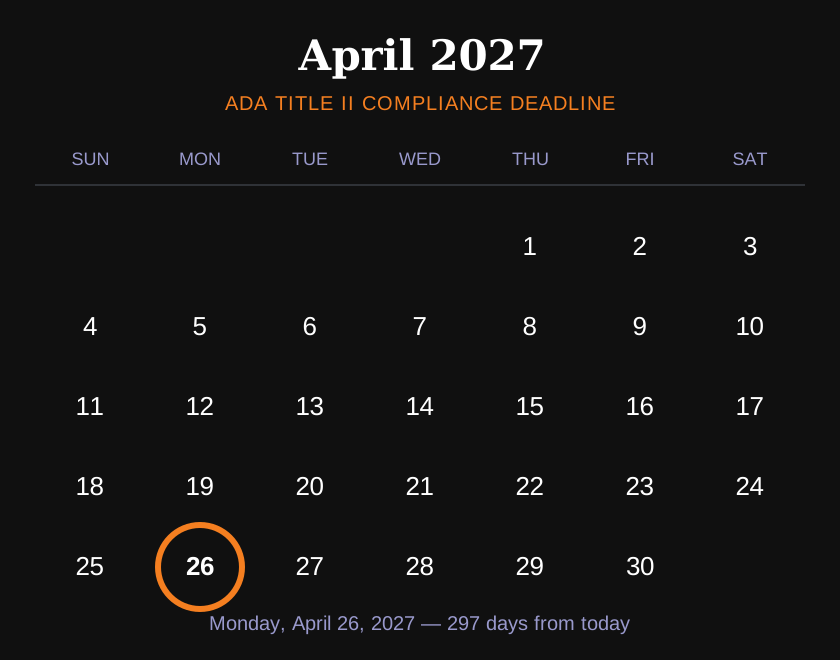
- Monday, April 26, 2027: For State and local government entities with a total population of 50,000 or more
- Wednesday, April 26, 2028: For the remaining government entities with a total population of less than 50,000, along with special district governments
At the time of this writing, that means those of you in the larger category have just 297 days to become fully compliant. Every day that goes by, the deadline looms closer, and we can all take bets together on whether the Federal government will extend again.
What does it take to become compliant? Quite an extensive amount of work. And our experience with some of the remediation vendors that our clients have hired is that the ball is being dropped. For example, a document that never had a title set and doesn’t have a valid language defined in the hidden metadata properties is an immediate liability, because a person with disabilities using a screen reader does not get the full context of the content. However, something we saw post remediation is a vendor stamping every document with the exact same title, which is arguably a violation of the ADA effective communication rule, as a person with disabilities cannot easily tell which document is which in a listing or after downloading multiple documents to their personal device.
Another area that we have seen underdiscussed is the archival exemption. The law allows documents older than a certain date to be exempt from remediation, but four specific requirements must be met, and the document alone cannot meet them without the website that links to it also being appropriately designed. The rules are found in § 35.104 Definitions. And to make matters tricky, in our experience the date on the document is often untrustworthy and does not represent the true date of that document. An easy example to understand is a Court order issued on one date and digitized years or even decades later. Quite often the date of digitization is left as the only date on the file, and the actual date is not easily searchable. This becomes critical to get right in the coming months after enforcement starts.
Rietta has introduced a new capability that allows us to help our government clients in this space. We are not getting into the business of being a remediation vendor, there are many good ones out there, but we can do something that none of them can. Independent review of a vendor’s compliance work should self-evidently carry more weight than the vendor’s own self-attestation of that same work, and we can provide exactly that kind of documented, independent evidence of an active compliance program.
- How many documents are not compliant with the requirements
- Why those documents are not compliant, and exactly where they are
- How to solve the problem, with clear guidance for your team
A big win with our methodology is that we have no stake in the cost per remediation of each file. So if our methodology finds that 80% of your documents meet the archival standards, we will tell your web developers to build a proper archive page so that no further changes need to be made to those files at all.
But perhaps most importantly, a one-time scan only solves half the problem. Your agency does not stop publishing documents the day after the compliance deadline passes; new PDFs, forms, and reports go up every week, and each one is a fresh opportunity to be out of compliance all over again. Software teams solved a nearly identical problem decades ago: rather than testing a product once before release and hoping nothing breaks afterward, they built automated checks that run every time something changes, catching problems before they ever reach a user. (Developers will recognize this as basically CI/CD, continuous integration and deployment, applied to documents instead of code.) We can apply that same discipline to your document workflow: instead of a single point-in-time audit, our tooling can continuously validate newly published documents as they appear, so compliance is not a project you finish once, it is a standing practice that keeps working long after the deadline has come and gone.
So far, I have talked exclusively about the liability risk. But let me take a moment to say that the reason we are here is that people with disabilities really struggle to make full use of this content. This goes back decades. Functionality was added to make webpages more accessible, but web design practice was slow to catch up. At the end of the day, it is exciting and rewarding to make the world a slightly better place for all of our neighbors. I am glad we can be a small part of that.
That said, we are here and have the capability to scan your site and offer you a free sample report. We will then look over the results together, and you can make an informed decision about the future of your compliance efforts. We would be honored to be a small part of your success story.
You can learn more on our dedicated Metadata Minder website, and schedule a consultation with our team there.